
Welcome to new readers of the American Geographical Society’s weekly, the AGS Globe! The Globe shares articles on geography and geospatial topics, as well as exciting opportunities and news from our network. As the world revolves, geography evolves. The mission of the AGS Globe is to bring our storied legacy of exploration and thought leadership into the frontiers of the future.
A Geological Tour of the High Atlas
By Joel Pomeroy
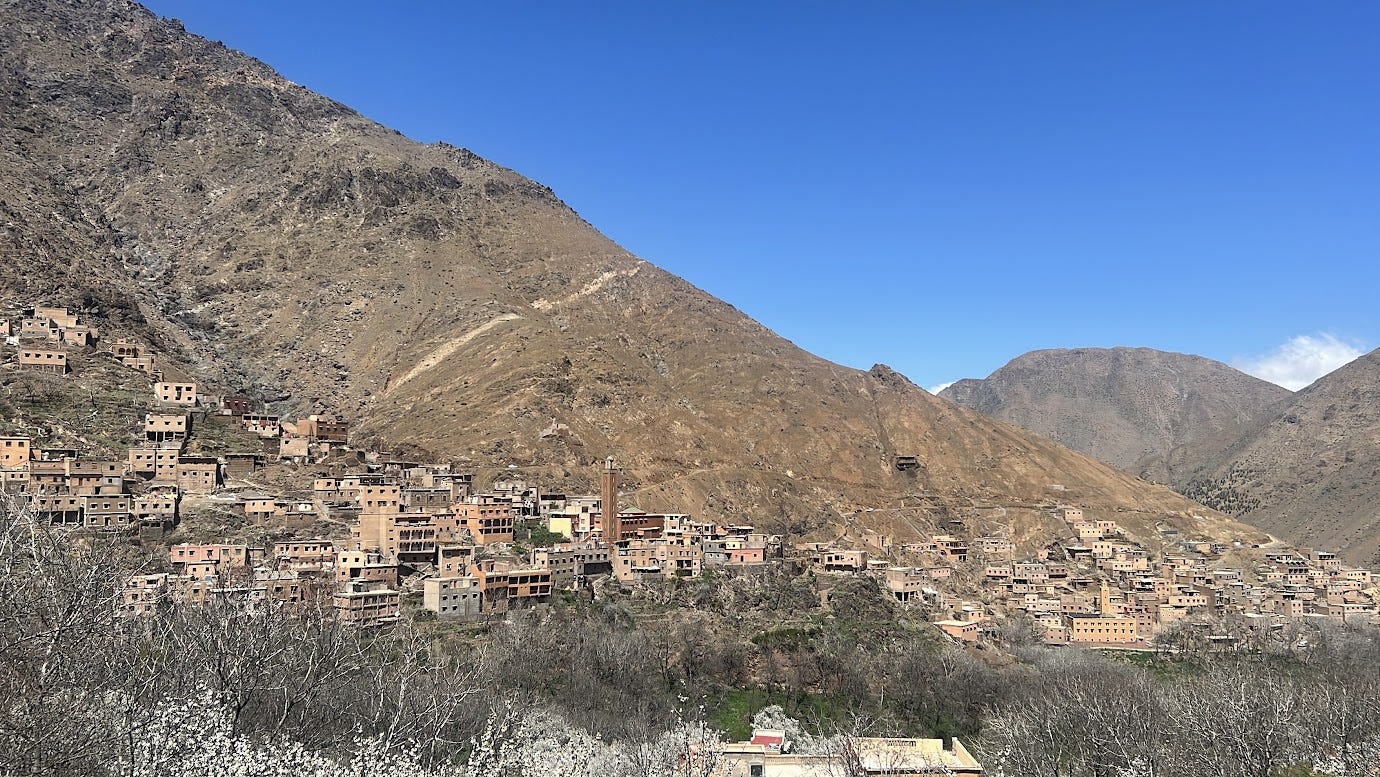
A farmer heaves burlap sacks of barley onto the back of a mule, the animal shifting its weight on the uneven mountain path. Nearby, children spill out of a small mud brick village school, shouting across the valley in Amazigh (Tashelhit). Soon the students’ voices will be drowned out by the muezzins whose songs harmonize and echo over the mountains, each calling their village to prayer. Daily life in Morocco’s Imlil Valley is molded by rhythms that have continued uninterrupted for centuries. Beneath the ground, far larger processes have shaped the region for millions of years.
Tucked within the High Atlas Mountains, the towns in the valley experience the effects of geology both at their most beautiful and most pernicious. The story of these peaks goes back millions of years to the Jurassic Period, during which the continents did not resemble those of today. At the time, the ancient Supercontinent of Pangea was splitting apart into two new massive landmasses, Gondwana and Laurasia. This pulling apart created cracks called faults, splitting parts of the Earth’s crust into large blocks, referred to as horsts and grabens by geologists.
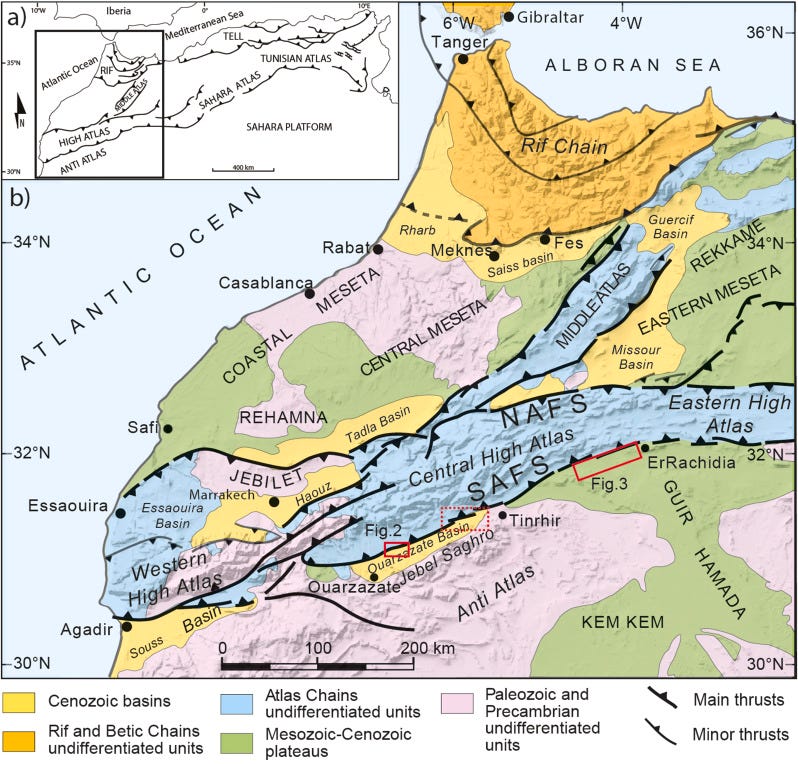
The events of the Jurassic laid important groundwork for the next stage of the development of the Atlas: uplift. In broad terms, this second process began with the collision of the African and Eurasian tectonic plates, which started slamming together roughly 100 million years ago. In fact, the changing tectonic forces caused the faults to experience “inversion”; cracks that had once allowed extension became mechanisms for contraction. In response, the crust was pushed upward in a series of fold and thrust belts forming the Atlas Mountains.
While the Atlas contains six subranges stretching across North Africa, some of the most dramatic topography is located around the Imlil Valley in the High Atlas. Here is located the tallest peak in all of North Africa, Mount Toubkal. At 4,000 meters (13,000 feet), Toubkal’s snowy apex has popularized the region for tourists and mountaineers alike. In fact, Toubkal is so high that the simple geologic story of extension and contraction does not match the characteristics of the underlying crust.
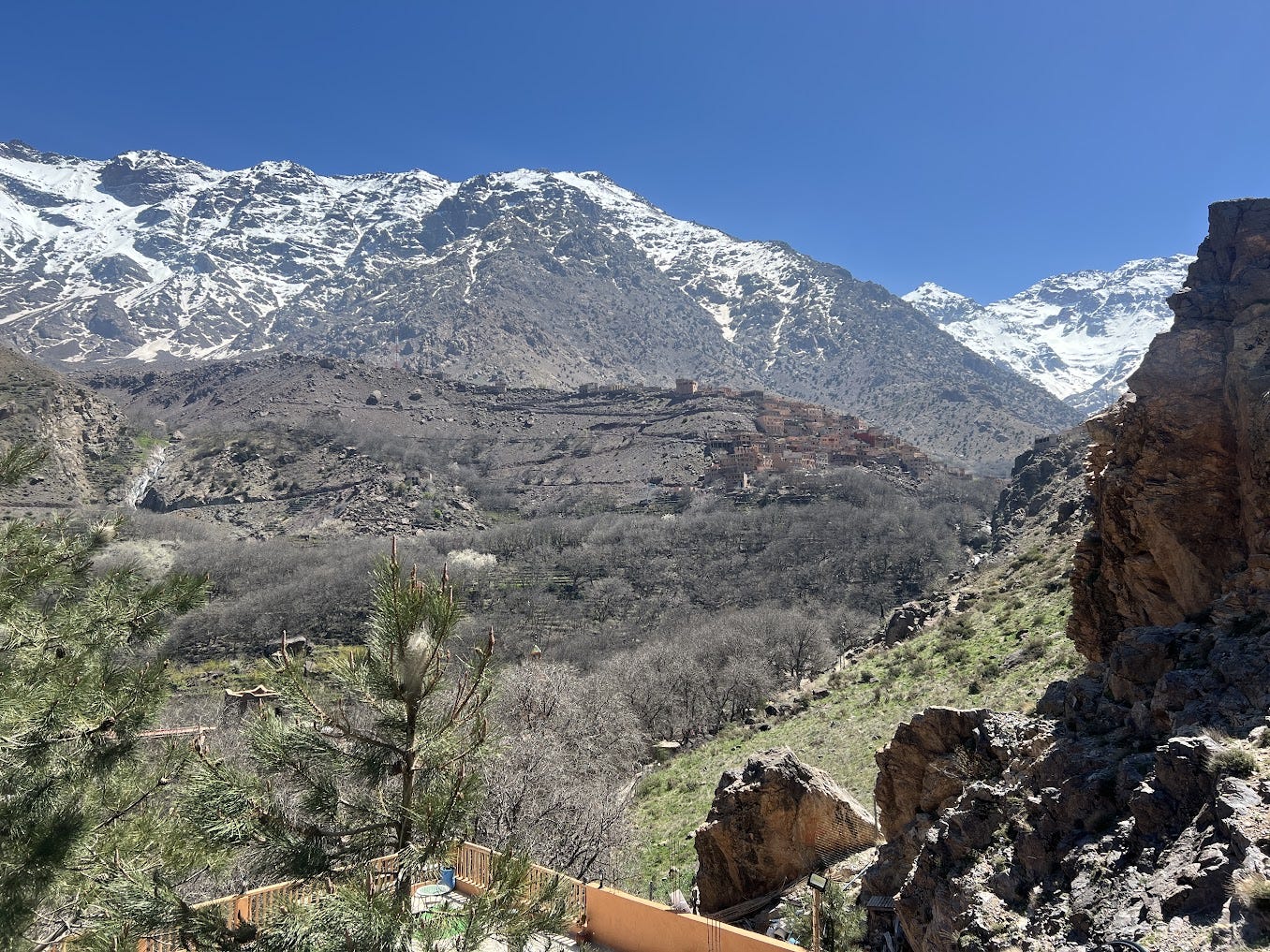
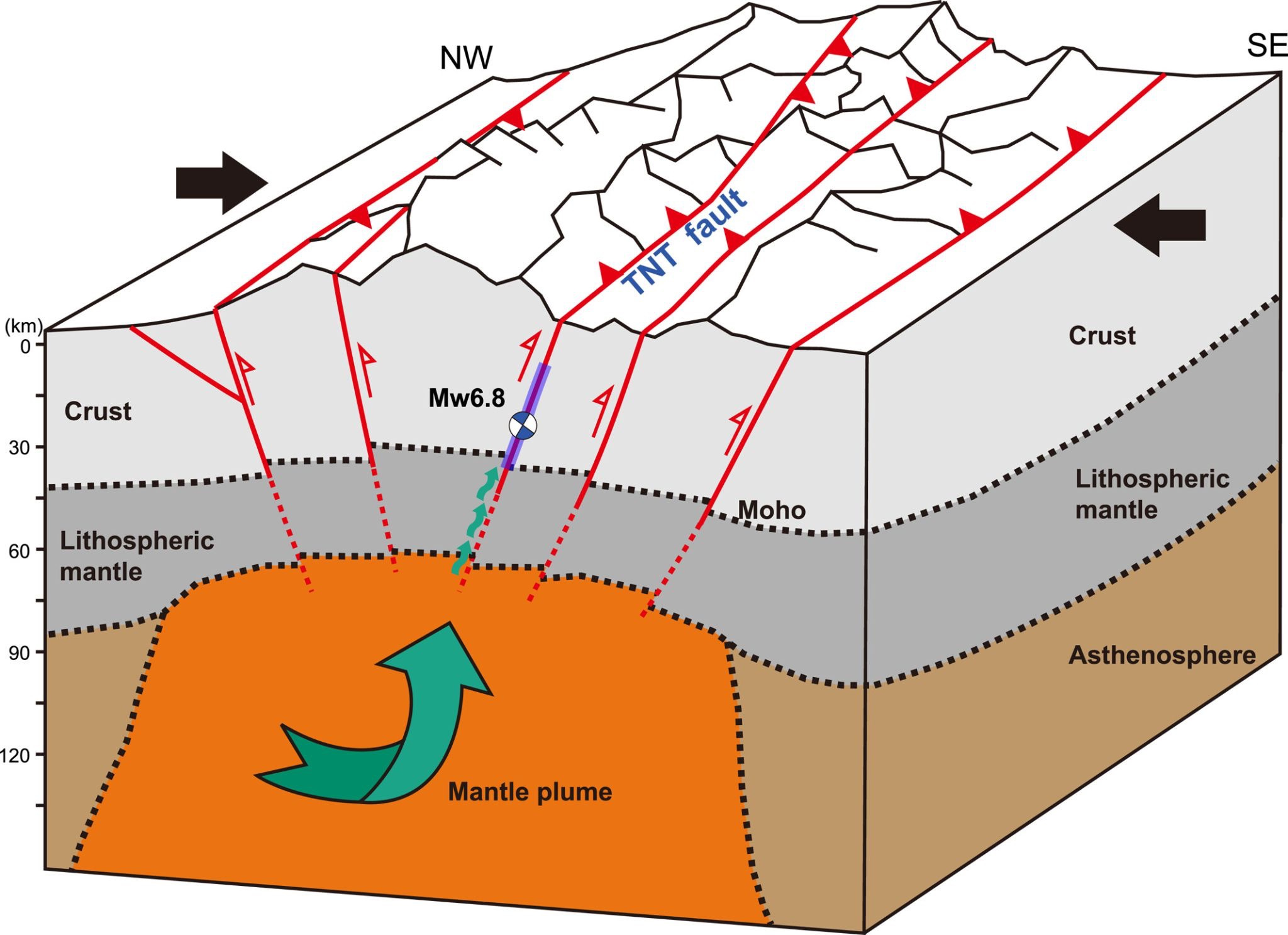
The problem largely comes down to a contradiction that geologists have known about since at least the 1990s. Typically, a tall mountain must be propped up by a wedge of crust sitting deep into the mantle (the layer beneath the Earth’s crust), the same way a large portion of an iceberg sits beneath the surface. However, observations show that throughout much of the Atlas the underlying crust is peculiarly thin. Instead, scientists have found something else underneath–an unusually hot patch of mantle rising beneath the range. While scientists are still uncertain, most models explaining the Atlas’s anomalous height relate to the effects of this mantle upwelling.
The geological gift of the Atlas, however, is not without negative consequences. In 2023, a 6.8 magnitude earthquake hit less than 47 km (30 miles) from Imlil, devastating the villages of the High Atlas. Many of the structures, built from clay and mud, were not well equipped to handle the intense shaking, which damaged or destroyed nearly 60,000 houses. In total, more than 2,900 people were killed in the Earthquake, the deadliest tremor in the country since 1960.
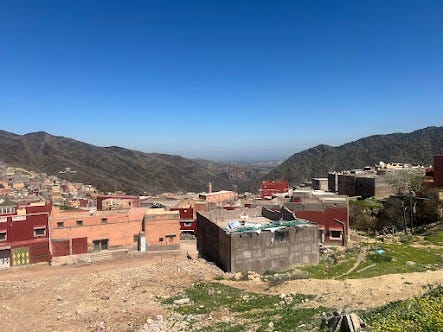
Large earthquakes like these are common along tectonic plate boundaries, where the plates’ grinding activates faults in the Earth’s interior. The Eurasian and African plates, though, converge over 250 kilometers (150 miles) north of the High Atlas in the Rif Mountains. Once again, the region’s peculiar mantle geology may yield the answer. Research from the Southern University of Science and Technology in Shenzhen, China, suggests that the hot, buoyant mantle below the Atlas stretches and flexes the Crust. According to this theory, when the stress reaches a certain threshold, the fault shifts, resulting in an earthquake.
As the dusk settles over the villages of Imlil valley, life continues its constant pace: the toiling farmer, the rowdy school children, and the end of the call to prayer. Even three years on, the community surrounding Imlil continues to deal with the devastation wrought by the 2023 Earthquake. Shrouded in the shadow of Mount Toubkal, they are reminded of the wonders and dangers of the mysterious Atlas’ geology.
References
Beauchamp, Weldon, Richard W. Allmendinger, Muawia Barazangi, Ahmed Demnati, Mohamed El Alji, and Mohammed Dahmani. 1999. “Inversion Tectonics and the Evolution of the High Atlas Mountains, Morocco, Based on a Geological-Geophysical Transect.” Tectonics 18 (2): 163–184. https://doi.org/10.1029/1998TC900015.
Beaumont, Peter. 2023. “‘My Neighbours Dug for Me with Bare Hands’: Morocco Earthquake Survivors Grapple with Loss and Chaos All Around.” The Guardian, 10 September. https://www.theguardian.com/world/2023/sep/10/it-felt-like-we-were-being-bombed-moroccan-earthquake-survivors-left-sleeping-outside.
Bergeron, Bénédicte. 2025. “Morocco: Two Years after the Earthquake: Where Do We Stand?” Caritas, 8 September. https://www.caritas.org/morocco/emergency/marocco-two-years-after-the-earthquake-where-do-we-stand/.
Huang, Kai, Guoguang Wei, Kai Chen, Naiqian Zhang, Mingjia Li, and Luca Dal Zilio. 2024. “The 2023 Mw 6.8 Morocco Earthquake: A Lower Crust Event Triggered by Mantle Upwelling?” Geophysical Research Letters 51: e2024GL109052. https://doi.org/10.1029/2024GL109052.
Lanari, Riccardo, Claudio Faccenna, Maria Giuditta Fellin, Abderrahim Essaifi, A. Nahid, F. Medina, and N. Youbi. 2020. “Tectonic Evolution of the Western High Atlas of Morocco: Oblique Convergence, Reactivation, and Transpression.” Tectonics 39 (3): e2019TC005563. https://doi.org/10.1029/2019TC005563.
Lee, Hwaju, Maximiliano J. Bezada, and YoungHee Kim. 2022. “The Origin of the Low-Velocity Anomalies Beneath the Rootless Atlas Mountains: Insights Gained from Modeling of Anisotropy Developed by the Travel of Canary Plume.” Journal of Geophysical Research: Solid Earth 127 (11): e2022JB024622. https://doi.org/10.1029/2022JB024622.
Metz, Sam. 2023. “7 Things to Know about the Devastating Morocco Earthquake.” PBS NewsHour, 11 September. https://www.pbs.org/newshour/world/6-things-to-know-about-the-devastating-morocco-earthquake.
NASA Earth Observatory. 2017. “Morocco’s High Atlas Mountains.” NASA Science, 25 January. https://science.nasa.gov/earth/earth-observatory/moroccos-high-atlas-mountains-89511/.
Sani, Federico, Giacomo Risaliti, Gioele Macchioni, Jacopo Nesi, Giovanna Moratti, Mauro Papini, and Marco Benvenuti. 2026. “Structural Analysis of the South Atlas Fault System (Morocco): Inferences about the Evolution of an Intraplate Chain in the Frame of the Atlantic Ocean Opening.” Journal of Structural Geology 209: 105713. https://doi.org/10.1016/j.jsg.2026.105713.
Seber, Dogan, Muawia Barazangi, Ben Aissa Tadili, Mohamed Ramdani, Aomar Ibenbrahim, and Driss Ben Sari. 1996. “Three-Dimensional Upper Mantle Structure beneath the Intraplate Atlas and Interplate Rif Mountains of Morocco.” Journal of Geophysical Research: Solid Earth 101 (B2): 3125–3138. https://doi.org/10.1029/95JB03112.
Spieker, Kathrin, Ingo Wölbern, Christine Thomas, Mimoun Harnafi, and Lahcen El Moudnib. 2014. “Crustal and Upper-Mantle Structure beneath the Western Atlas Mountains in SW Morocco Derived from Receiver Functions.” Geophysical Journal International 198 (3): 1474–1485. https://doi.org/10.1093/gji/ggu216.
Did you enjoy reading this? Support the American Geographical Society today with a donation of $50 to help us support Geography education.

Members of the American Geographical Society enjoy reduced-price access to AGS events and free access to the online version of Geographical Review.


You are invited to our 175th Anniversary globe signing event on September 15th at the Explorers Club in New York City, featuring renowned explorer, oceanographer, and astronaut Dr. Kathy Sullivan. Support the Society’s 175 Campaign with a gift of $175 or more and receive an invitation to this exclusive event, where you’ll have the opportunity to see one of the world’s most extraordinary historical artifacts gain its newest signature. Join us on September 15 as we celebrate the explorers who have shaped our understanding of the world—and help ensure that the spirit of exploration continues to inspire future generations.
Submit Lightning Talk and Exhibition Poster Proposals Today! Speak at our annual fall symposium, Geography 2050: Africa Shaping Tomorrow, taking place this November 19-20, 2026, at the Schomburg Center for Research in Black Culture in New York City! By 2100, over one-third of the world’s population will live in Africa, already the world’s youngest and fastest-growing continent, with profound implications for the interconnected human and environmental dimensions of the transformative demographic and technological boom across Africa. Submit proposals to speak at Geography2050 here!
Our Geography 2050 Trip Planning Page is Up! You can view information about this year’s venue and our partner hotels with Special Symposium Rates. Early birds can register for the lowest ticket price and book their stay at Aloft Harlem or the Renaissance New York Harlem Hotel at this special rate TODAY by going to the Geography 2050 Trip Planning page.